Chasing the Last Tram Home: Manchester's Gig Curfew Is a Choice, Not a Law of Nature
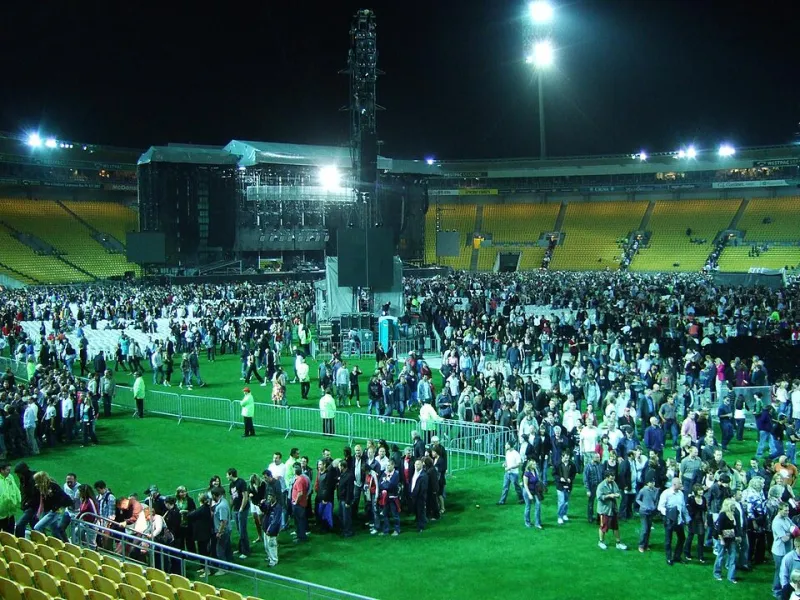
Photo: Edward Hyde from Tauranga, New Zealand, CC BY-SA 2.0, via Wikimedia Commons
There is a very specific kind of Manchester gig that ends with a sprint. Not a dash for the barrier, not a stage dive — a dash for the tram. Doors at seven, support at half seven, headliner on at nine, last note somewhere around twenty to eleven, and then a few hundred people pour out onto Oxford Road or into the Northern Quarter at exactly the same moment, phones out, thumbing at a transport app, doing the maths on whether the last Metrolink to Altrincham is a realistic ambition or a work of fiction.
Nobody designed it like this. The bands didn't ask for it. The promoters certainly didn't. But the curfew has quietly become the headline act on the city's gig calendar, and it's shaping what Manchester music actually sounds like — how long a set can be, who can afford to play it, and who gets to stay to the end.
The Difference Between Ten and Half Eleven
Ask anyone who promotes in this city and they'll tell you the same thing: it's rarely the licensing that squeezes the night. It's the transport. A room can be cleared for a midnight finish on paper, but if the last tram leaves the city centre around half eleven and the last of the useful night buses follow not long after, then a midnight finish is a theoretical pleasure most of the audience can't enjoy.
So the maths gets done backwards. Headliner on at nine, forty-five or fifty minutes if they're lucky, an encore that's really just two songs and a thank you, and a room half emptied by the time the final chorus arrives because people with a two-bus journey home have already made their choice. Support acts get twenty-five minutes and a crowd that's still finding its feet. New bands get the most hostile slot of the night and the least chance to convert anyone.
What Gets Lost
The obvious casualty is set length. Plenty of Manchester headliners play shorter headline sets here than they do in Leeds on a Saturday, and the difference isn't ambition, it's arithmetic.
The less obvious casualty is the long tail. The bit after the gig — the merch table, the chat with the support band, the pint that turns into a plan, the promoter who finally gets introduced to the drummer everyone's been banging on about. That's where a lot of Manchester's musical relationships actually start. It's also the first thing to go when everyone's watching the clock.
And there's the audience nobody talks about: the people on the last train back to Stockport, the ones on a coach out of Bolton, the ones who have to be up at six. A night out in the city is a bigger commitment from Wigan than from Withington, and a curfew that ignores that quietly narrows the scene down to people who live within a cheap taxi ride of the venue.
Others Manage It
Worth saying plainly: plenty of UK cities have wrestled with this and some have landed in a better place. Bristol's late-night transport culture is famously more generous. Leeds and Liverpool both have pockets of the city centre where a half-eleven finish still leaves you a fighting chance of getting home. Glasgow's licensing debate has been noisy and imperfect, but it at least treats nightlife as something with a cultural value rather than an administrative inconvenience.
Manchester has an extraordinary concentration of venues in a walkable centre — a genuine advantage most cities would kill for. It also has one of the most punishing last-mile problems in the country once you step outside that centre. Those two facts sit awkwardly together, and they explain a lot about the shape of our gig calendar.
So What Would Actually Help
Nobody is asking for a free-for-all. The realistic asks, from the people who book the rooms, tend to look like this:
- Later, more frequent services on the key radial routes after gigs finish, even if it's a limited late-night loop rather than a full timetable.
- Licensing flexibility that follows the transport, so venues aren't punished for finishing at midnight when the alternative is a hundred people walking home in the dark.
- Better coordination between venues and transport planners, so a big show at one room doesn't leave everyone hitting the same stop at the same minute.
- Honest conversations about support-slot lengths, because a twenty-five-minute set is not a fair audition for anybody.
The Bit Where It Gets Personal
A city that closes early doesn't just lose a few encores. It loses the accidental conversations that turn into bands, the support act who gets noticed because the room stuck around, the fan who buys the record because they had time to stand at the merch table and talk rubbish for ten minutes.
Manchester's reputation was built on nights that ran long enough to become stories. Protecting that isn't about being soft on noise complaints or nostalgic for some imagined golden age. It's about recognising that the last tram is a cultural decision as much as a transport one — and that a city which bills itself as the home of music should probably be willing to keep the lights on long enough to prove it.