Shot in the Dark: The Front-Row Photographers Turning Manchester's Small Gigs Into Big Followings
A Scene You Can Scroll
There was a time, not so long ago, that a brilliant local band played to a room of eighty people and the only evidence it happened was a few blurry phone clips and a crumpled setlist. Now? By the time the support act has cleared their amps, there are forty photographs of the set doing the rounds, each one shot like a record sleeve, each one tagged, credited and shared to an audience bigger than the venue holds in a month.
Something has shifted in Manchester, and it's worth writing down properly, because future historians of this city's music will look back at this exact moment.
From the Balcony to 50k
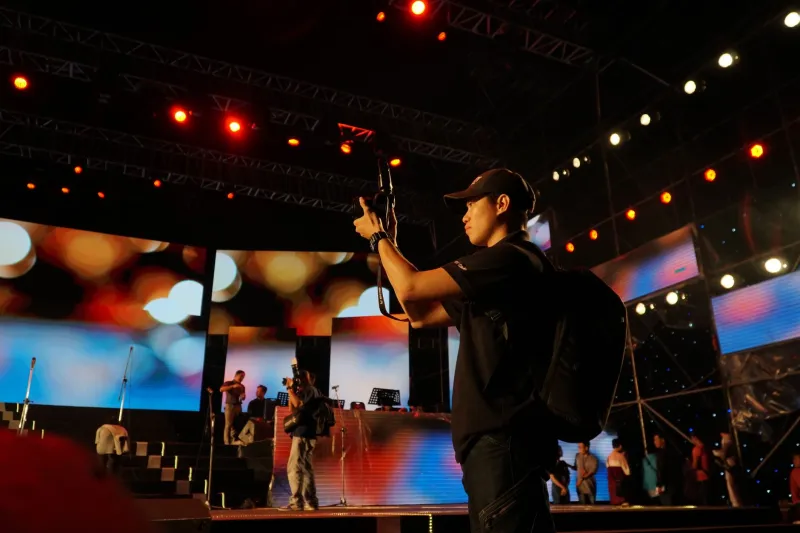
Talk to the young shooters working the smaller rooms — the Academy 3s, the Deaf Institutes, the basements of the city — and a pattern emerges. Most of them started the same way: a cheap camera, a mate's band, a night with nothing to lose. One good frame gets posted, the band shares it, the band's audience follows the photographer, and suddenly the photographer has an audience of their own.
We spoke to one shooter who built a following north of fifty thousand almost entirely from gigs in rooms holding fewer than 300 people. Their earliest archives are a time capsule of the local scene — bands that went on to sign deals, venues that have since closed, faces that are now familiar from festival lineups. "I wasn't trying to build anything," they told us. "I just didn't want to forget the nights. Turns out nobody else wanted to either."
That's the quiet engine of it: these galleries have become the scene's collective memory. Scroll the feed of any decent Manchester photographer and you're not just seeing pictures — you're seeing the city's next three years of lineups, documented in advance.
The New Gatekeepers
Here's where it gets interesting, and slightly uncomfortable. When a photographer with a huge following posts a band, that band's reach changes overnight. A single well-shot gallery can do more for an unsigned act than months of gigging. Labels and booking agents have noticed; some now ask, politely or otherwise, who's shooting the show.
It's a new kind of power, and unlike the old A&R model, it's not held by people in offices in London — it's held by twenty-somethings with blacked-out clothes and a spot at the barrier. To their credit, most of the shooters we spoke to are acutely aware of it. Several talked about deliberately rotating which bands they feature, about shooting support acts nobody asked them to shoot, about using their platform to lift rooms rather than just the bands already buzzing.
"The pit's small enough that we all know each other," one told us. "If we all shoot the same three bands, the scene gets really boring, really fast. So we don't."
Writing Tomorrow's Archive
It's worth zooming out. Every great era of Manchester music history survives partly because someone stood in the right place with a camera. The images we associate with the city's golden nights weren't accidents — they were people with access, instinct and the nerve to raise a camera in a crowd.
What's different now is scale and speed. The archive is being built in real time, in public, by dozens of people at once. Where previous generations left us a handful of iconic frames per era, this one is leaving thousands. Future fans won't have to imagine what an unsigned Manchester band looked like in a 200-cap room in the mid-2020s. They'll be able to see it, lit beautifully, from the front row.
One Small Ask
If you're a gig-goer: credit the photographers when you share their work. If you're in a band: pay them, or at least buy them a pint — that gallery you're using as your profile picture didn't take itself. And if you're one of the shooters: keep going. You're not just documenting the scene.
You're deciding what it gets to remember.