Fall Outs and Fallout: The Band Feuds That Left Their Mark on Manchester
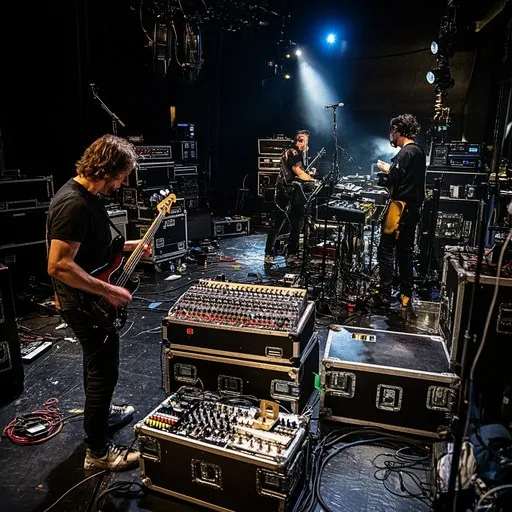
Photo: rock band argument backstage music venue dramatic, via images.stockcake.com
Manchester is a small city with a massive music scene, and that combination — intimate geography, enormous ambition — has always been a recipe for spectacular conflict. When everyone knows everyone, when the same fifty venues rotate the same circuit of bands, when last night's support act is tomorrow's headline competition, things get personal fast. They always have.
The city's history of musical feuds is long, occasionally hilarious, and — if you look at it properly — genuinely revealing about how creativity and community coexist under pressure.
The Venue Ban: Manchester's Ultimate Sanction
Before we get into specific feuds, it's worth understanding the particular power of the venue ban in Manchester's ecosystem. Being barred from a venue in this city isn't just a professional inconvenience. It's a social event. Word travels faster than any press release, and in a scene where promoters, sound engineers, bar staff, and musicians all drink in the same ten pubs, a ban from the Deaf Institute or Night & Day is the kind of thing people are still talking about three years later.
"It's not like London where you can just move to a different borough and start again," says one veteran promoter who has worked Manchester venues for over fifteen years. "Here, you bump into the person you fell out with at the Tesco Metro on Oxford Road. There's no escape. Which means either the grudges last forever or everyone eventually has to make peace."
Sometimes both happen simultaneously.
When Creative Differences Get Loud
The most common source of band feuds in Manchester — as anywhere — is the creative argument that crosses a line. Songwriting credit disputes, arguments over artistic direction, one member deciding the band needs to go in a different direction while everyone else disagrees. These are universal. What makes Manchester's version distinctive is the speed at which they become public.
The city's music press — and its successor, the network of blogs, podcasts, and social media accounts that replaced it — has always had a taste for the dramatic. A heated exchange at a soundcheck becomes a "war of words." A cancelled support slot becomes a "bitter split." The scene has a tendency to mythologise its own conflicts, which means the feuds themselves often grow in the telling.
That mythologising isn't always harmless. Several Manchester musicians have spoken candidly about how a single public falling-out — sometimes over something genuinely trivial — followed them for years, colouring how promoters and labels perceived them before they'd even played a note.
The Liam and Noel Effect
It would be impossible to talk about Manchester band feuds without acknowledging the shadow cast by the Gallagher brothers. Whatever you think of Oasis — and opinions in this city remain strong, varied, and occasionally unprintable — Liam and Noel demonstrated something important: that a feud conducted publicly and with genuine venom doesn't necessarily destroy a legacy. Sometimes it becomes the legacy.
The Oasis split in 2009 — backstage at the Rock en Seine festival in Paris, a guitar reportedly involved — was the culmination of decades of very Manchester-style conflict: passionate, petty, hilarious, and ultimately rooted in two people who cared deeply about the same thing disagreeing about everything else. The reunion announcement in 2024 only proved that in Manchester, even the most terminal-seeming feuds have a half-life.
Younger Manchester bands watched all of this and drew different conclusions. Some saw it as proof that drama generates attention. Others saw it as a cautionary tale about what happens when ego overtakes everything else.
Rivalries That Made the Scene Better
Not every conflict is purely destructive. Manchester has a long tradition of rivalries that pushed both parties to be better — competing bands who drove each other harder because neither could stand the thought of the other pulling ahead.
In the mid-2000s, the city's post-punk revival threw up half a dozen bands chasing the same venues, the same press coverage, and the same handful of A&R contacts who occasionally made the trip up from London. The competition was fierce and sometimes unfriendly. But several of the musicians involved now credit that rivalry with forcing them to sharpen their songwriting, tighten their live shows, and develop a genuine identity rather than resting on early promise.
"There was a band we absolutely hated," admits one musician from that era, laughing. "We would not have made our second album without them. The thought of them doing better than us was genuinely unbearable. So we worked harder. I owe them, honestly."
The band in question, for the record, split up in 2009. The musician in question played their farewell gig. "Of course I did," he says. "Manchester."
When It Gets Genuinely Ugly
Not all feuds end in reluctant mutual respect. Manchester's scene has its share of conflicts that left real damage — careers derailed, friendships permanently broken, bands that should have been great torn apart before they got the chance to find out.
The pattern, when it gets ugly, tends to involve a combination of factors: financial stress, substance issues that the scene has historically been too quick to romanticise, and the particular claustrophobia of a tight-knit community where there's no neutral ground. When everything happens in the same square mile, there's nowhere to decompress.
Several Manchester musicians have spoken in recent years about the need for the scene to get better at supporting people through conflict rather than spectating on it. The romanticisation of chaos — the idea that drama is proof of authenticity — has a real cost that doesn't always show up until years later.
What the Feuds Actually Tell Us
Strip away the gossip and the mythology and Manchester's band feuds are really just evidence of how much people care. You don't have spectacular fallouts over things that don't matter. The arguments that define scenes — about direction, about credit, about who gets to speak for what the music means — are arguments about identity. About art. About the gap between what something is and what it could be.
Manchester has always taken its music seriously enough to fight about it. That's not always comfortable, and it's not always pretty. But it's also, in its own chaotic way, a sign of a scene that's genuinely alive.